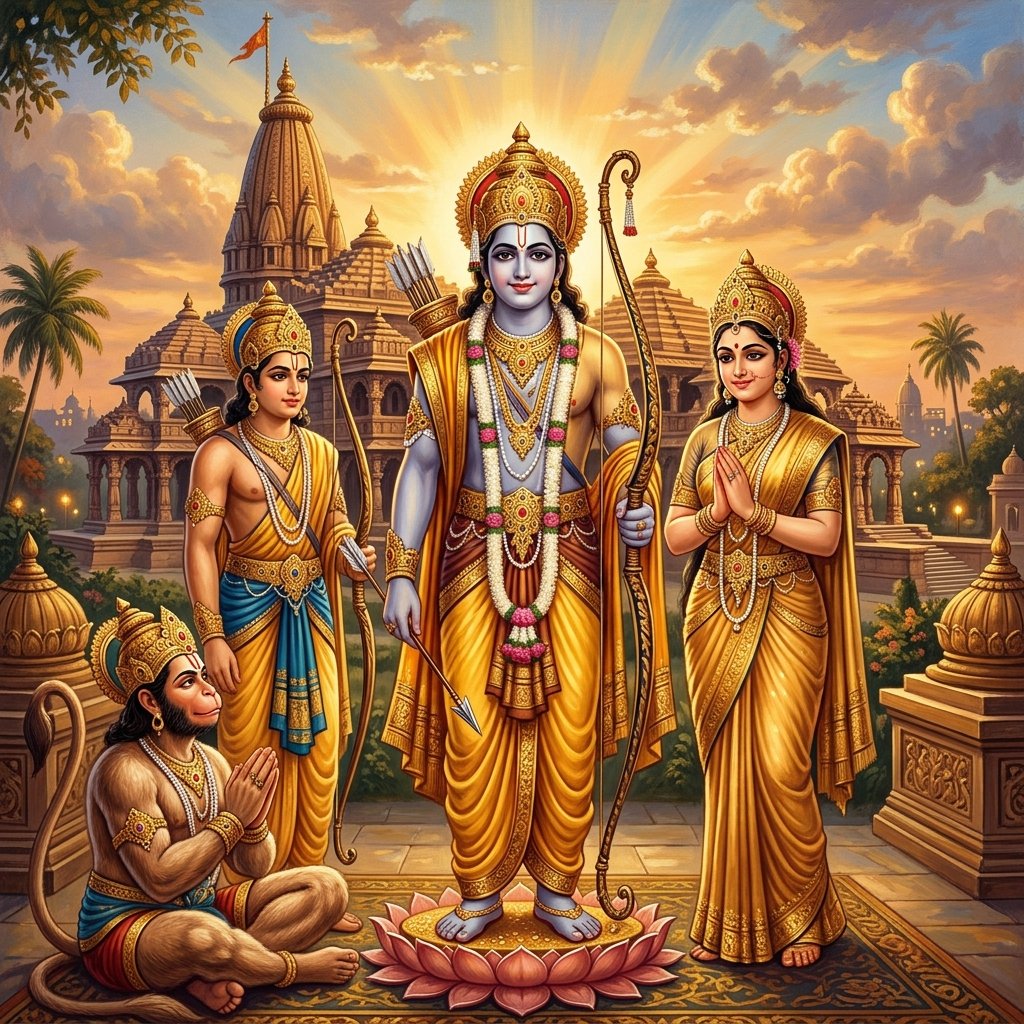
Shri Ayodhya Dham
🏛️ 1ST MOKSHA PURI • RAM JANMABHOOMI

Shri Ayodhya Dham

Shri Ram Janmabhoomi Mandir • 📍 Ayodhya, Uttar Pradesh, India

The eternal birthplace of Maryada Purushottam Lord Shri Rama and the ancient solar capital of the Ikshvaku Dynasty along the sacred Sarayu River, Shri Ayodhya Dham is the foremost of the seven holy Moksha Puris, crowned by the majestic newly consecrated Ram Janmabhoomi Mandir.

🪔
Presiding Deity Lord Shri Ram Lalla Sarkar (5-Year-Old Child Form) & Mata Sita
👑
Divine Lineage Suryavansha (Solar Dynasty of Ikshvaku, Raghu, and Dasharatha)
🌊
Holy River & Kunds Sacred Sarayu River, Surya Kund, and Sita Kund
Historical Antiquity Treta Yuga; Newly Consecrated Ram Mandir on 22 January 2024
🏛️
Architectural Style Grand Gurjara-Nagara Style in Carved Bansi Paharpur Pink Sandstone
🚩
Major Festivals Ram Navami (Surya Tilak), Deepotsav (Diwali Mega Illumination), Vivah Panchami
Advertisement

🏛️ Detailed History & Sacred Architecture

Ayodhya, meaning "the city that cannot be conquered in battle," was founded by Manu, the progenitor of mankind, as chronicled in the Valmiki Ramayana. It flourished as the illustrious capital of the Suryavanshi kings—including Emperor Ikshvaku, Harishchandra, Raghu, and Maharaja Dasharatha—culminating in the divine advent of Lord Shri Rama in Treta Yuga. For thousands of years, the sacred birthplace (Ram Janmabhoomi) remained a vibrant beacon of Sanatana faith and culture.

Following a historic civilizational quest spanning nearly five centuries, the grand new Shri Ram Janmabhoomi Mandir was consecrated (Pran Pratishtha) on 22 January 2024. Designed by the celebrated Sompura family of temple architects, the monumental 3-storey temple is built entirely from pink sandstone quarried from Bansi Paharpur (Rajasthan) without using a single kilogram of iron or structural steel, engineered by scientists at CBRI Roorkee to endure for over a millennium. Inside the sanctum, the 51-inch Krishna Shila deity of 5-year-old Ram Lalla, sculpted by master artist Arun Yogiraj, radiates supreme innocence, tranquility, and divine sovereignty.

📜 Sacred Pauranik Legends & Divine Leelas

The Ayodhya Mahatmya of the Skanda Purana describes the sacredness of Ayodhya: simply entering its perimeter cleanses the soul of past transgressions. When Lord Rama concluded His earthly incarnation (Avatara Leela), He walked into the waters of the Sarayu River accompanied by the devoted citizens of Ayodhya, ascending together to the heavenly realm of Vaikuntha.

Another beloved legend tells of Hanumangarhi: when Lord Rama returned triumphant from Lanka, He gifted this high fortified hillock to Lord Hanuman to watch over and protect the city of Ayodhya. To this day, tradition decrees that every pilgrim must first pay their respects to Kotwal Hanumanji at Hanumangarhi before proceeding to seek the blessings of Ram Lalla at the Janmabhoomi. Furthermore, on every Ram Navami at exact noon, an astonishing optical system devised by Indian scientists illuminates the forehead of Ram Lalla with a precise, celestial Surya Tilak using concentrated solar rays.

🌟 Spiritual Glory & Vedic Hymns

Ayodhya is celebrated as the first of the seven sacred Moksha Puris: "Ayodhya Mathura Maya Kashi Kanchi Avantika | Puri Dvaravati Chaiva Saptaite Mokshadayikah ||". The temple stands not merely as stone and mortar, but as an eternal symbol of righteousness, cultural endurance, and dharma.

रामो विग्रहवान् धर्मः साधुः सत्यपराक्रमः। राजा सर्वस्य लोकस्य देवानाम् इव वासवः॥
English Meaning: "Rama is the personification of Dharma itself, pious, endowed with unfaltering truth and valor; He is the supreme sovereign of all the worlds, just as Indra is the ruler of the gods."

🛕 Sanctum Sanctorum, Sacred Kunds & Highlights

✨ Ram Janmabhoomi Mandir

The 3-storey stone masterpiece with 5 ornate mandapas (Nritya, Rang, Sabha, Prarthana, and Kirtan), 392 sculpted pillars, and the sanctum of Ram Lalla.

✨ Miracle Surya Tilak System

An optomechanical marvel designed by CBRI Roorkee and IIA Bengaluru that directs sunlight onto Ram Lalla’s forehead on every Ram Navami noon.

✨ Hanumangarhi Fortress Temple

The 10th-century fortress temple perched on 76 steps where Lord Hanuman resides as the divine sovereign protector of Ayodhya.

✨ Kanak Bhawan (The Golden Palace)

The ornate palace gifted by Queen Kaikeyi to Devi Sita upon her wedding, housing deities of Rama and Sita wearing gold crowns.

✨ Ram Ki Paidi & Sarayu Ghats

The sprawling riverfront steps on the holy Sarayu where millions of earthen lamps are lit during the annual Diwali Deepotsav Guinness World Record.

✨ Nageshwarnath Temple

An ancient Shiva temple established by Lord Rama’s son Kusha, honoring a celestial Nagakanya.

⏰ Darshan Vidhi, Temple Rules & Daily Aarti Timetable

Pilgrims traditionally begin the pilgrimage with a holy bath at the Sarayu River (Ram Ki Paidi), visit Hanumangarhi for blessings, and then enter the Ram Janmabhoomi complex. Modern entry passes (Sugam Darshan) and free general queues are facilitated seamlessly via the Shri Ram Janmabhoomi Teerth Kshetra portal.

Aarti / Sacred Ritual Prescribed Timings
Mangala Aarti (Pre-Dawn Waking) 06:30 AM
Shringar Aarti & Public Morning Darshan 07:00 AM - 11:30 AM
Bhog Aarti & Midday Rest 11:30 AM - 01:30 PM
Afternoon & Evening Darshan 01:30 PM - 07:00 PM
Sandhya Aarti 07:00 PM - 07:30 PM
Shayan Aarti & Temple Closure 09:30 PM - 10:00 PM
Advertisement

🚗 Complete Pilgrimage Travel Guide (How to Reach & Accommodation)

✈️ By Air

Maharishi Valmiki International Airport, Ayodhya Dham (AYJ) is located just 10 km from the Ram Mandir, operating daily flights from Delhi, Mumbai, Ahmedabad, Bengaluru, and Chennai.

🚆 By Train

Ayodhya Dham Junction is an architectural marvel designed like a temple, equipped with airport-style lounges. Ayodhya Cantt Station also connects to major railway hubs across India.

🚗 By Road

Ayodhya is connected via four-lane national highways to Lucknow (130 km), Varanasi (200 km), Gorakhpur (140 km), and Prayagraj (160 km).

🗓️ Best Time to Visit

October to March offers delightfully pleasant weather. Ram Navami (March/April) and Diwali (October/November) host the world-renowned Deepotsav.

🏨 Accommodation

Dharamshalas, pilgrim tent cities, luxury heritage homestays, and newly opened international hotels provide comfortable accommodations.

🌸 Sacred Stotrams, Mantras & Aartis for Worship

Recite these dedicated stotrams, Vedic mantras, and chalisas to attain the divine grace of the presiding deity:

💡 Frequently Asked Questions (Pilgrim Guide)

❓ Why must devotees visit Hanumangarhi before Ram Janmabhoomi?

According to sacred tradition, Lord Rama appointed Hanuman as the royal guardian and ruler of Ayodhya. Taking the permission and blessings of Hanumanji first is deemed essential for fulfilling one’s pilgrimage to Ayodhya.

❓ What is the technological secret behind the Surya Tilak of Ram Lalla?

Engineered by scientists at CBRI Roorkee and the Indian Institute of Astrophysics, an optomechanical system of brass pipes, mirrors, and convex lenses redirects sunlight at exact noon on Ram Navami to create a 75 mm circular tilak on Ram Lalla’s forehead for 4 to 5 minutes.

❓ What stone is used to carve the deity of Ram Lalla?

The 51-inch deity is carved from 2.5-billion-year-old Krishna Shila (black schist stone) sourced from Jaya Nagar in Mysuru, Karnataka by sculptor Arun Yogiraj. It does not react with milk, water, or kumkum.

❓ How far is the new Ayodhya Airport from the temple?

Maharishi Valmiki International Airport is approximately 10 kilometers away, reachable in 20-25 minutes by taxi or electric shuttle bus.

🕉️ Explore Other Sacred Hindu Pilgrimages

Discover detailed guides for India's Char Dham, 12 Jyotirlingas, Sapta Puri, and overseas temples on our comprehensive pilgrimage portal.

← View All Sacred Pilgrimages 📿 Chant with Digital Japa Mala →