Maa Durga

Sharad Navratri 2026

Ashwin Shukla Pratipada to Navami · 11 – 19 October 2026 · Vijayadashami (Dussehra) on 20 October

Sharad Navratri begins on Sunday, 11 October 2026.

Key Dates for Navratri 2026

The tithi timings below are for Prayagraj. Other cities will differ by a few minutes.

OccasionDateTithi timing (Prayagraj)
Ghatasthapana (Navratri begins)Sunday, 11 OctoberPratipada: 9:21 PM on 10 Oct to 9:33 PM on 11 Oct
Mahashtami (Durga Ashtami)18 October*Ashtami: 8:29 AM on 18 Oct to 10:53 AM on 19 Oct
MahanavamiMonday, 19 OctoberNavami: 10:53 AM on 19 Oct to 12:52 PM on 20 Oct
Vijayadashami (Dussehra)Tuesday, 20 OctoberDashami: 12:52 PM on 20 Oct to 2:13 PM on 21 Oct
* Why do panchangs differ on the date of Mahashtami? This year Ashtami tithi begins during the day on 18 October and lasts until the morning of 19 October. Calendars that anchor Ashtami to midday give 18 October, while many North Indian panchangs hold the Ashtami and Navami observances on 19 October. The Ashtami–Navami junction (Sandhi Puja) falls on the morning of 19 October, roughly between 10:29 and 11:17 AM. For your own observance, confirm with your local panchang or priest.

Ghatasthapana Muhurat — 11 October 2026

Pratipada tithi lasts all day on 11 October. However, Chitra nakshatra (until 10:33 PM) and Vaidhriti yoga (until 9:05 PM) also last the whole day. The classical rule discourages Ghatasthapana during Chitra nakshatra and Vaidhriti yoga, so when both persist all day, kalash sthapana in the Abhijit Muhurat is considered best. Many panchangs also list a morning window; given the rule above, the Abhijit Muhurat is the more appropriate choice.

📍 Prayagraj — Sunday, 11 October 2026
Sunrise05:59 AM
Abhijit Muhurat (recommended)11:26 AM - 12:13 PM
Morning window (first one-third of the day)05:59 AM – 09:53 AM
Pratipada tithi ends09:33 PM
NakshatraChitra — until 10:33 PM
YogaVaidhriti — until 09:05 PM
Timings are calculated astronomically and shift with each city's latitude and longitude. You can also choose your location on the Panchang page. For the full kalash sthapana procedure and materials, see the Ghatasthapana puja vidhi (in Hindi).

Nine Days, Nine Goddesses

During Navratri the nine forms of Navadurga are worshipped in order. The sequence comes from the well-known Devi Kavacham verse that begins “Prathamam Shailaputriti dvitiyam Brahmacharini.” The dhyana verses and bhog below are traditional; bhog varies by region.

Day 1 Sunday, 11 October

Maa Shailputri

Ashwin Shukla Pratipada

Daughter of Himalaya, the king of mountains. Seated on a bull, holding a trident in her right hand and a lotus in her left. Navratri begins with her worship and Ghatasthapana.

वन्दे वाञ्छितलाभाय चन्द्रार्धकृतशेखराम्।
वृषारूढां शूलधरां शैलपुत्रीं यशस्विनीम्॥
Vande vanchhita-labhaya chandrardha-krita-shekharam / Vrisharudham shuladharam Shailaputrim yashasvinim
Traditional bhog: pure cow's ghee
Day 2 Monday, 12 October

Maa Brahmacharini

Ashwin Shukla Dwitiya

The goddess of austerity and self-restraint, holding a rosary in her right hand and a kamandalu (water pot) in her left. She represents the severe penance undertaken to win Lord Shiva as her husband.

दधाना करपद्माभ्यामक्षमालाकमण्डलू।
देवी प्रसीदतु मयि ब्रह्मचारिण्यनुत्तमा॥
Dadhana karapadmabhyam akshamala-kamandalu / Devi prasidatu mayi Brahmacharinyanuttama
Traditional bhog: sugar or mishri (rock sugar)
Day 3 Tuesday, 13 October

Maa Chandraghanta

Ashwin Shukla Tritiya

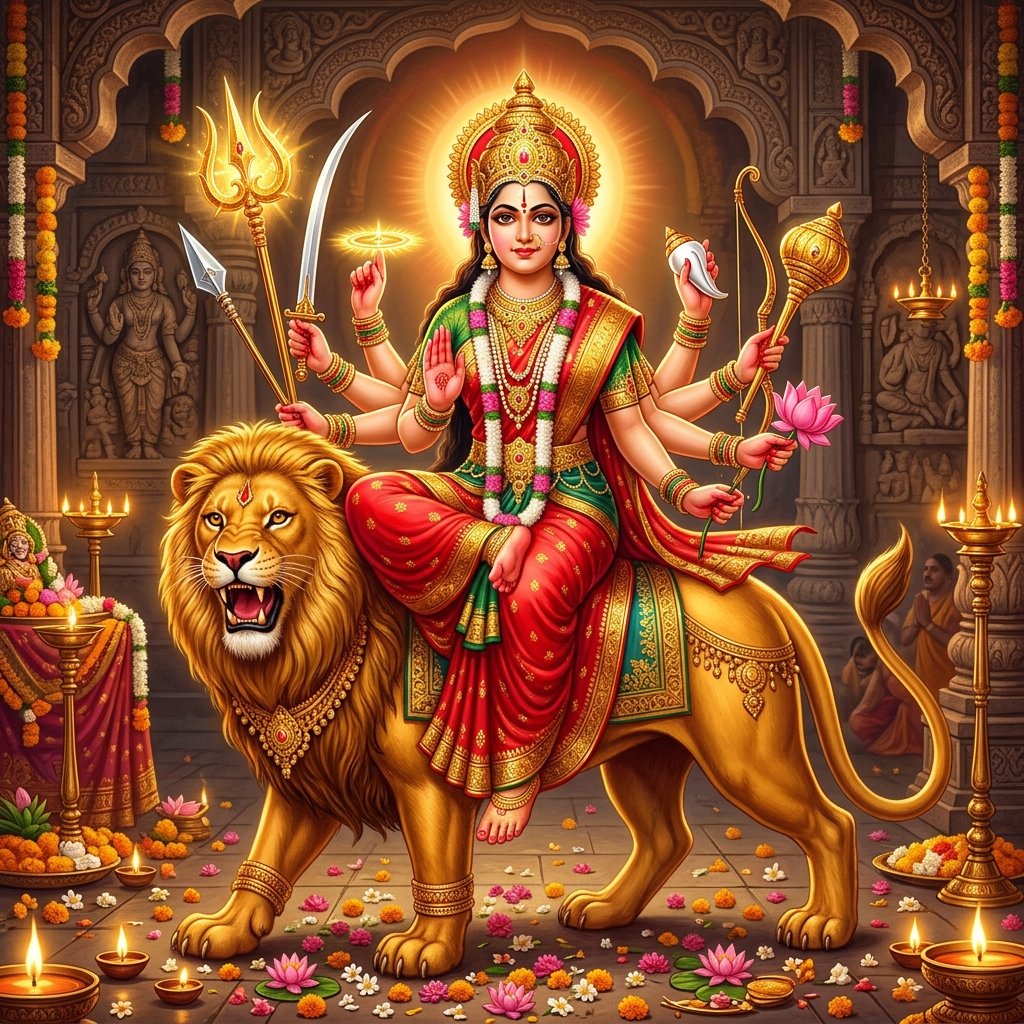
Wears a bell-shaped half-moon on her forehead. Rides a lion and has ten arms. The goddess who removes fear and distress and brings peace of mind.

पिण्डजप्रवरारूढा चण्डकोपास्त्रकैर्युता।
प्रसादं तनुते मह्यं चन्द्रघण्टेति विश्रुता॥
Pindaja-pravararudha chanda-kopastrakairyuta / Prasadam tanute mahyam Chandraghanteti vishruta
Traditional bhog: milk and kheer (rice pudding)
Day 4 Wednesday, 14 October

Maa Kushmanda

Ashwin Shukla Chaturthi

Believed to have created the universe with her gentle smile. Eight-armed and riding a lion; her radiance is said to light up every direction.

सुरासम्पूर्णकलशं रुधिराप्लुतमेव च।
दधाना हस्तपद्माभ्यां कूष्माण्डा शुभदास्तु मे॥
Surasampurna-kalasham rudhiraplutameva cha / Dadhana hasta-padmabhyam Kushmanda shubhadastu me
Traditional bhog: malpua
Day 5 Thursday, 15 October

Maa Skandamata

Ashwin Shukla Panchami

Mother of Kartikeya (Skanda). Seated on a lotus with the infant Skanda in her lap; her mount is the lion. A form of motherhood and tenderness.

सिंहासनगता नित्यं पद्माश्रितकरद्वया।
शुभदास्तु सदा देवी स्कन्दमाता यशस्विनी॥
Simhasana-gata nityam padmashrita-karadvaya / Shubhadastu sada devi Skandamata yashasvini
Traditional bhog: banana
Day 6 Friday, 16 October

Maa Katyayani

Ashwin Shukla Shashthi

Born as the daughter of the sage Katyayana. The form who slew Mahishasura; her mount is the lion. The tradition also describes the gopis of Braj worshipping her.

चन्द्रहासोज्ज्वलकरा शार्दूलवरवाहना।
कात्यायनी शुभं दद्याद्देवी दानवघातिनी॥
Chandrahasojjvala-kara shardula-vara-vahana / Katyayani shubham dadyad devi danava-ghatini
Traditional bhog: honey
Day 7 Saturday, 17 October

Maa Kalaratri

Ashwin Shukla Saptami

A fierce yet ever-auspicious form that destroys darkness and fear. Her mount is the donkey. This year Saptami touches two sunrises, on both 17 and 18 October.

एकवेणी जपाकर्णपूरा नग्ना खरास्थिता।
लम्बोष्ठी कर्णिकाकर्णी तैलाभ्यक्तशरीरिणी॥
Ekaveni japakarnapura nagna kharasthita / Lamboshthi karnikakarni tailabhyakta-sharirini
Traditional bhog: jaggery
Day 8 Sunday, 18 October

Maa Mahagauri

Ashwin Shukla Ashtami

Fair-complexioned and riding a bull; a form of purity and peace. Many households perform kanya pujan on Mahashtami. (Panchangs give the Ashtami date as 18 or 19 October; see the note above.)

श्वेते वृषे समारूढा श्वेताम्बरधरा शुचिः।
महागौरी शुभं दद्यान्महादेवप्रमोददा॥
Shvete vrishe samarudha shvetambaradhara shuchih / Mahagauri shubham dadyan mahadeva-pramodada
Traditional bhog: coconut
Day 9 Monday, 19 October

Maa Siddhidatri

Ashwin Shukla Navami

The bestower of all siddhis, seated on a lotus. Havan and kanya bhoj are traditional on Navami. This is the last day of Navratri.

सिद्धगन्धर्वयक्षाद्यैरसुरैरमरैरपि।
सेव्यमाना सदा भूयात् सिद्धिदा सिद्धिदायिनी॥
Siddha-gandharva-yakshadyair asurair amarair api / Sevyamana sada bhuyat siddhida siddhidayini
Traditional bhog: sesame seeds, and halwa-puri-chana
Dashami Tuesday, 20 October

Vijayadashami (Dussehra)

The close of Navratri. The nine-day fast is broken (parana), and the Aparahna period of Dashami is considered the time for Vijaya puja. In Prayagraj, Dashami begins at 12:52 PM.
Fasting and Kanya Pujan

General fasting rules

  • Sattvic diet: fruits, milk and curd, kuttu or singhara flour, sabudana, samak rice, potatoes.
  • Use rock salt (sendha namak); avoid grains, onion and garlic, meat and alcohol.
  • Bathe in the morning, take the sankalp, light a lamp and remember the Devi of the day.
  • Try to keep restraint, truthful speech and to avoid anger during these days.
  • Health comes first: the unwell, elderly and pregnant women should keep the rules simple, with medical advice where needed.

Kanya pujan

  • On Ashtami or Navami (as per your tradition), nine girls and one boy are honoured.
  • Wash their feet, offer a seat, apply tilak and serve them food.
  • Halwa, puri and black chana are the usual prasad.
  • Offer a small gift or dakshina afterwards and seek their blessings.
  • This year the Ashtami date differs between panchangs (see above), so confirm the day with your priest or panchang.

🪔 In Prabhu Vandan's View: Navratri Follows the Tithi, Not the Calendar

Last year Sharad Navratri began on 22 September; this year it begins on 11 October, a full 19 days later. The reason is that 2026 repeats the month of Jyeshtha as an adhik maas (17 May to 15 June), which shifts every festival forward to keep the lunar year in step with the solar one. Navratri does not arrive “on this date” each year; it arrives on Ashwin Shukla Pratipada, and the Pratipada is set by the motion of the moon.

The same logic is why counting the nine days is not always straightforward. This year Saptami touches two sunrises, while the Ashtami–Navami junction falls on the morning of 19 October. On the day of Ghatasthapana, Chitra nakshatra and Vaidhriti yoga both last all day, so the shastras point us to the Abhijit Muhurat. This is not confusion but the fine print of the tradition: when every rule cannot be satisfied at once, it has already decided which option is the least flawed.

The tradition also views the nine nights as three phases of three: the first three for Durga (dissolving inertia and bad tendencies), the next three for Lakshmi (building inner wealth), and the last three for Saraswati (discernment and knowledge). If you like, make that your own nine-day plan: give up one habit in the first phase, adopt one good habit in the second, and set aside some time each day for reading and reflection in the third.

What to Read During Navratri

❓ Frequently Asked Questions

1. When is Sharad Navratri 2026?

Sharad Navratri 2026 begins on Sunday, 11 October (Ashwin Shukla Pratipada) and runs through 19 October (Navami). Vijayadashami (Dussehra) falls on Tuesday, 20 October 2026.

2. What is the Ghatasthapana muhurat?

Pratipada tithi lasts all day on 11 October (until about 9:33 PM). Chitra nakshatra and Vaidhriti yoga also last the whole day, so the Abhijit Muhurat is considered the best time for kalash sthapana. In Prayagraj it is 11:26 AM to 12:13 PM; in Delhi roughly 11:45 AM to 12:31 PM. Use the calculator on this page for your own city.

3. When are Ashtami and Navami in Navratri 2026?

By Prayagraj timings, Ashtami runs from about 8:29 AM on 18 October to about 10:53 AM on 19 October, and Navami from then until about 12:52 PM on 20 October. That is why some panchangs place Mahashtami on 18 October and others on 19 October, while Mahanavami is 19 October in most. Please confirm with your local panchang or priest.

4. What can I eat while fasting during Navratri?

Traditionally a sattvic, fruit-based diet is followed: fruits, milk and curd, kuttu (buckwheat) or singhara (water chestnut) flour, sabudana, samak rice, potatoes and rock salt. Grains such as wheat and rice, onion and garlic, and meat and alcohol are avoided. Rules vary slightly by region and family tradition.

5. Is it necessary to fast all nine days?

No. According to faith and ability, people fast for all nine days, only on the first and last days, or only on Ashtami. Pregnant women, the elderly and anyone unwell should put their health first and consult a doctor if needed.

Tithi, nakshatra, yoga and muhurat timings are calculated astronomically (Lahiri ayanamsa) and cross-checked against several established panchangs. For any religious observance, please confirm with your local panchang or priest.